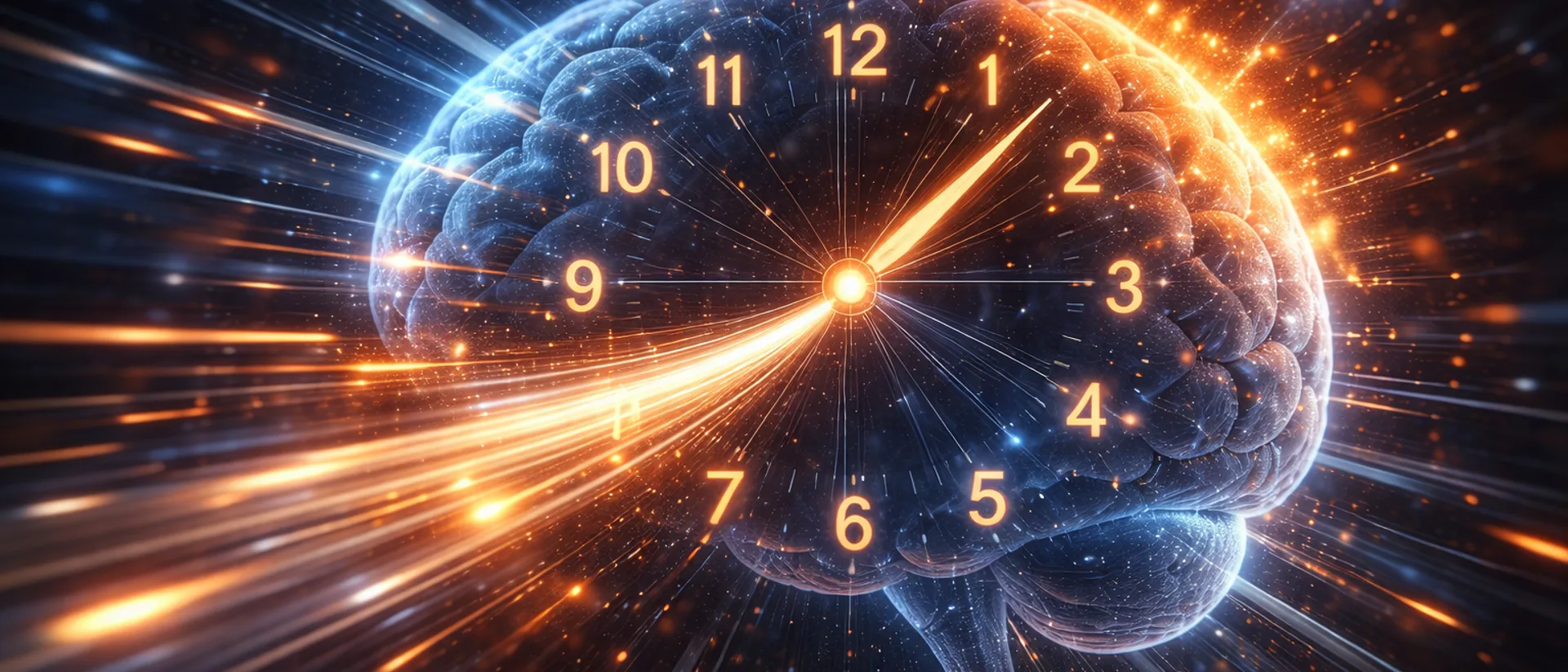
Your brain runs on an 80-millisecond delay. Everything you experience has already happened. You have never perceived the present moment.
The Ghost in the Machine: Your Brain Lives 80 Milliseconds in the Past
Your conscious experience is a carefully constructed lie. The "now" you perceive is already a memory, processed and presented by your brain after the fact. You are a ghost, forever haunting the immediate past.
You Are Not a Witness, But a Narrator
Light hits your retina. Sound vibrates your eardrum. These signals are not immediate experiences. They are raw data, traveling along neural pathways at finite speeds.
Your brain must integrate these disparate signals. It stitches them into a coherent, seamless story you call reality. This editing process takes time—roughly 80 milliseconds.
What you perceive as the present moment is actually a post-processed reconstruction. You are not living in real-time. You are watching a slightly delayed broadcast of your own life.
The Library of Almost-Now
Think of your consciousness as a librarian. Sensory information arrives constantly, like new books being delivered. The librarian doesn't hand you each book as it arrives.
Instead, they wait for a complete set. They bind the visual, auditory, and tactile pages together into a single volume labeled "Now." This binding creates the illusion of simultaneity.
Your brain makes predictive calculations to smooth this delay. It anticipates what should happen next, creating a feeling of continuity. When you catch a ball, your brain is predicting where it will be, not reacting to where it is.
The Philosophical Chasm of 80 Milliseconds
This delay creates an unbridgeable gap between the world and your mind. The universe unfolds in a continuous, flowing present. Your consciousness receives it in discrete, delayed packets.
The "present moment" as a philosophical concept does not exist in your experience. It is always just out of reach, having already slipped into the past by the time you become aware of it.
This raises a haunting question. If you never experience the present, what are you? You are not a being inhabiting the now. You are a process of constant recollection, a story being told to itself.
The Eternal Editor of Reality
Your brain is not a passive receiver. It is an active editor, cutting, splicing, and narrating the film of your existence. The 80-millisecond buffer is its editing room.
In that tiny window, it corrects errors, fills in blind spots from eye movements, and synchronizes senses. It creates the stable, logical world you navigate. Without this delay, reality would be a chaotic, jumbled mess of unsynchronized signals.
Your seamless reality is a beautiful, necessary illusion. The delay is not a bug in the system. It is the fundamental feature that allows a coherent "you" to exist at all.
So you sit there, reading these words. But you aren't. You are processing the memory of having read them, a fraction of a second after your eyes moved across the screen. The thinker, the thought, and the moment of thinking are forever separated by a silent chasm of 80 milliseconds. You are always remembering yourself into existence, one delayed perception at a time, forever a step behind a present that is always already gone.
Frequently Asked Questions
Is the 80-millisecond delay the same for everyone?
Does this mean free will is an illusion?
How do we function in real-time, like catching a ball?
If we perceive the past, what is 'now' actually like?
Verified Fact
Well-established in neuroscience. The delay for visual consciousness is estimated between 50-80ms, with other senses varying. This is known as the "time of conscious perception" or "perceptual latency."
View source