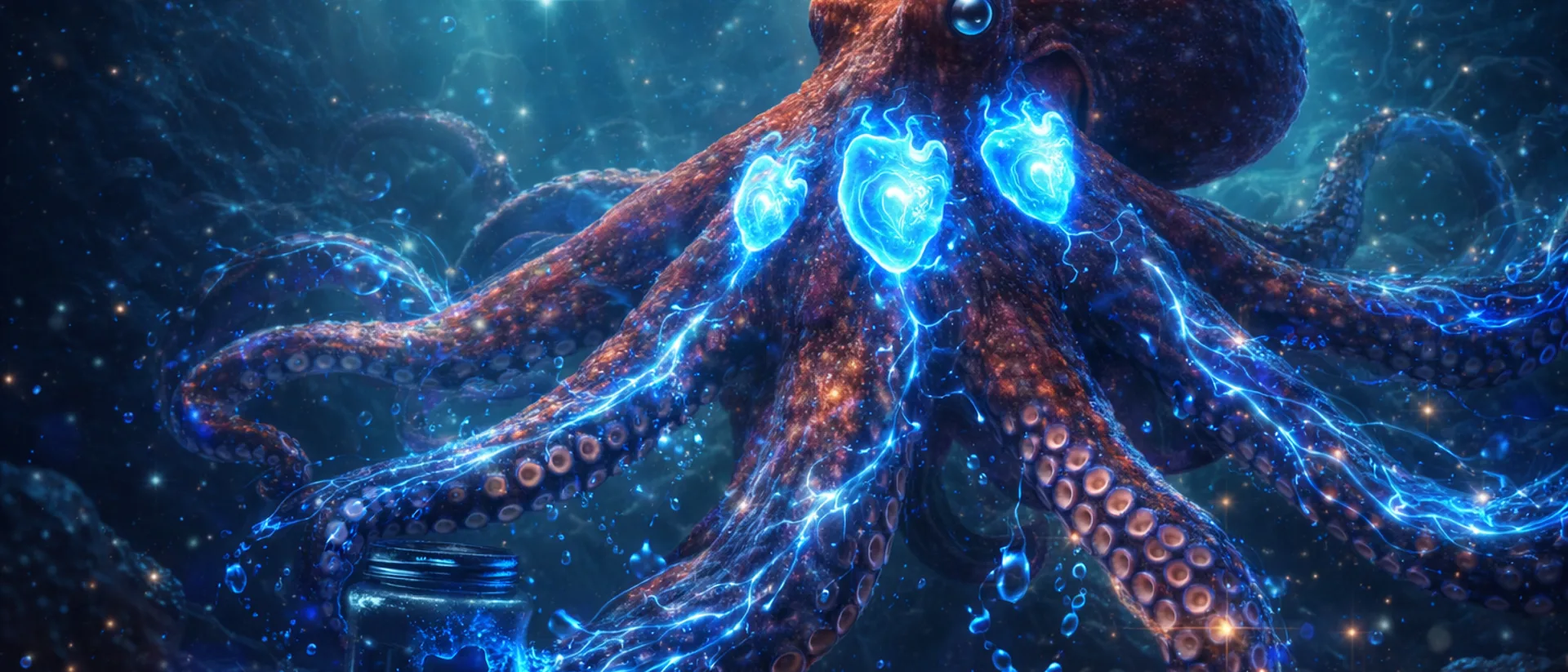
Octopuses have three hearts—two pump blood to the gills, one pumps it to the body. Their blood is blue because it uses copper-based hemocyanin instead of iron. Each of their 8 arms has its own mini-brain that can act independently—an arm can "decide" to open a jar while the central brain focuses on something else.
You Are One Self. An Octopus Is a Committee of Selves.
You probably think consciousness is a singular, centralized experience—a 'you' housed behind your eyes. An octopus experiences reality as a decentralized parliament, with eight autonomous limbs capable of independent decision-making, all powered by three hearts pumping alien, blue blood.
- Blood Chemistry: Their blood is blue due to copper-based hemocyanin, which is less efficient in oxygen transport than our iron-based hemoglobin, yet powers a staggeringly complex neural network.
- Cardiac Redundancy: Two of their three hearts stop beating when they swim, a biological paradox where exertion requires a partial cardiac shutdown.
- Neural Distribution: Over 60% of an octopus's neurons are not in its central brain, but spread throughout its arms, creating localized centers of awareness.
- Alien Cognition: An arm severed from the body can still reach, grasp, and attempt to feed a phantom mouth for up to an hour.
The Illusion
We perceive intelligence as a top-down hierarchy. A command center issues orders to dumb limbs.
This model feels intuitive because it mirrors our own experience of self. We assume a creature's cognitive unity is as certain as its bodily unity.
The Truth
The octopus body is not a unified kingdom ruled by a brain. It is a federation.
Each arm has its own mini-brain and can process complex tasks—solving puzzles, twisting jar lids, tasting through suckers—while the central brain is preoccupied. The central brain can issue a vague command like "find food," and the arm executes the mission with its own problem-solving intelligence.
Their blue, copper-based blood is a colder, slower river of life compared to our warm, iron-rich rush. It sustains a form of thought that is fundamentally distributed and parallel, not linear and focal.
The Implication
This shatters the cornerstone of how we define a conscious "self." Is the octopus one being, or a collaboration of nine?
Its experience of reality is likely incomprehensible to us—a haunting mosaic of sensations and semi-independent intentions. What does a thought feel like when it originates not behind your eyes, but in your fingertips?
We search the cosmos for alien intelligence. A profoundly different model of mind, one that questions the very architecture of consciousness, has been evolving in Earth's oceans for 300 million years.
If your sense of "I" is an unshakable truth, consider the octopus. Its existence suggests selfhood is not a universal constant, but a possible evolutionary configuration. What other forms of awareness are possible, right here, that our singular minds cannot even conceive?
Frequently Asked Questions
Does this mean an octopus arm has its own consciousness?
What is the evolutionary advantage of having three hearts and blue blood?
If their arms can act independently, how does the octopus avoid self-conflict?
What does the octopus's alien biology imply about life elsewhere in the universe?
Verified Fact
Factual details regarding octopus anatomy (three hearts, hemocyanin, neural distribution in arms) are well-documented in peer-reviewed marine biology literature.
View sourceRelated Topics
More from Nature