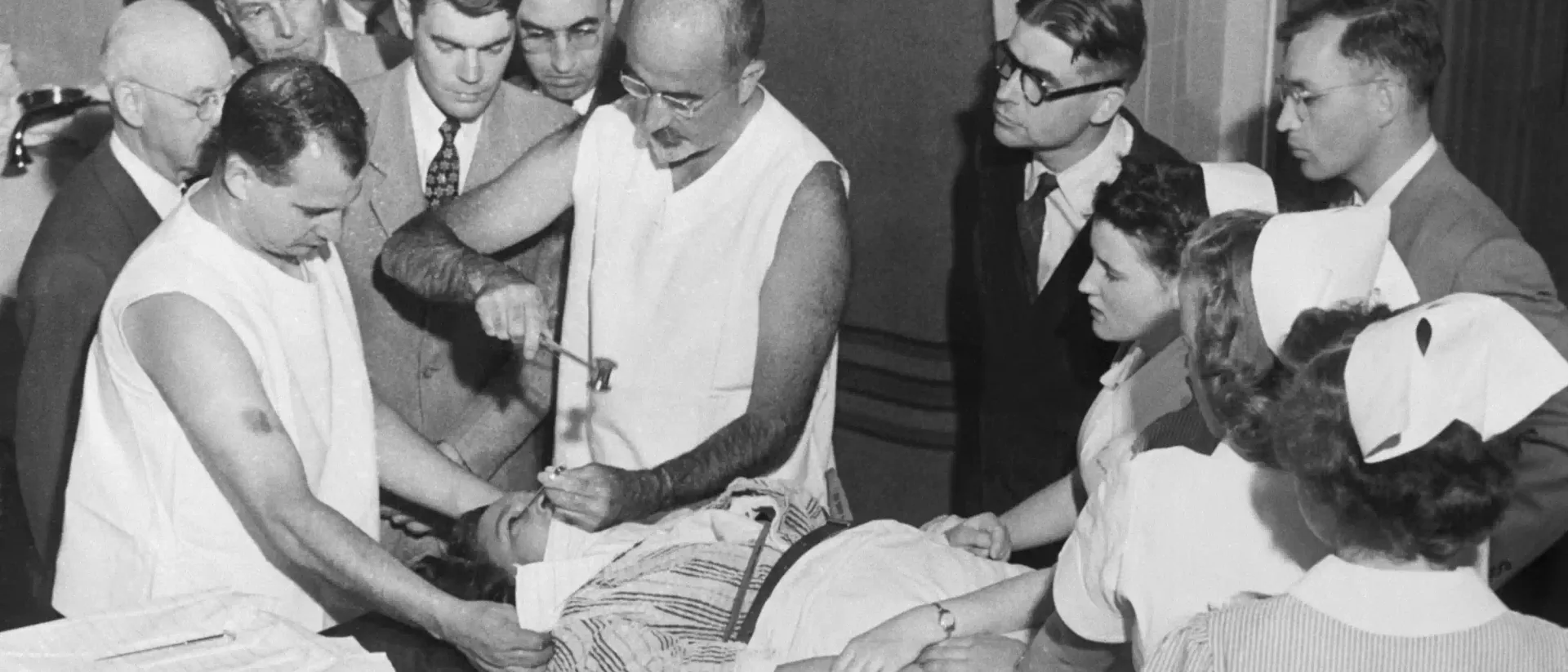
Walter Freeman toured the U.S. in his "lobotomobile," performing ice-pick lobotomies through the eye socket — sometimes on children as young as 4, at their parents' request.
The Doctor With the Ice Pick
Between the 1940s and 1960s, a doctor drove across the United States in a van, stopping at hospitals and mental institutions. He carried an instrument shaped like an ice pick. He used it on children.
Walter Freeman's Invention
Dr. Walter Freeman didn't invent the lobotomy, but he perfected the assembly-line version. His "transorbital lobotomy" required no operating room, no anesthesia, no surgeon. He would render the patient unconscious with electroshock, insert a leucotome (an ice pick-like instrument) through the eye socket, and sever connections in the prefrontal cortex.
The procedure took about 10 minutes. He performed it in offices, in hospital hallways, in front of audiences. He called it a cure.
The Lobotomobile
Freeman traveled the country in a van he openly referred to as his "lobotomobile." He drove from hospital to hospital, performing lobotomies on dozens of patients per visit. Some institutions scheduled him like a visiting performer.
He personally performed an estimated 3,400 lobotomies over his career. Many patients were left with permanent cognitive damage. Some died on the table.
The Children
Freeman's youngest patients were as young as 4 years old. Parents brought their children in for behavioral problems — tantrums, defiance, bed-wetting. Freeman drove his pick through their eye sockets and called them cured.
Howard Dully was lobotomized at age 12 because his stepmother found him "defiant." He survived and wrote a memoir about it decades later. Many others were not so fortunate — or so articulate.
No One Stopped Him
Freeman was not a rogue criminal. He was a respected physician at George Washington University. He published papers. He trained others. The medical establishment watched him drive from state to state, lobotomizing children, and did nothing until it was far too late.
He lost his medical license in 1967 — only after a patient died during a procedure. By then, he had already altered thousands of brains. The damage was permanent, the silence deafening, and the lobotomobile had long since completed its tour.
Frequently Asked Questions
How young were the children who received lobotomies?
What was the lobotomobile?
How many lobotomies did Walter Freeman perform?
When did Freeman lose his medical license?
Related Topics
More from Brain