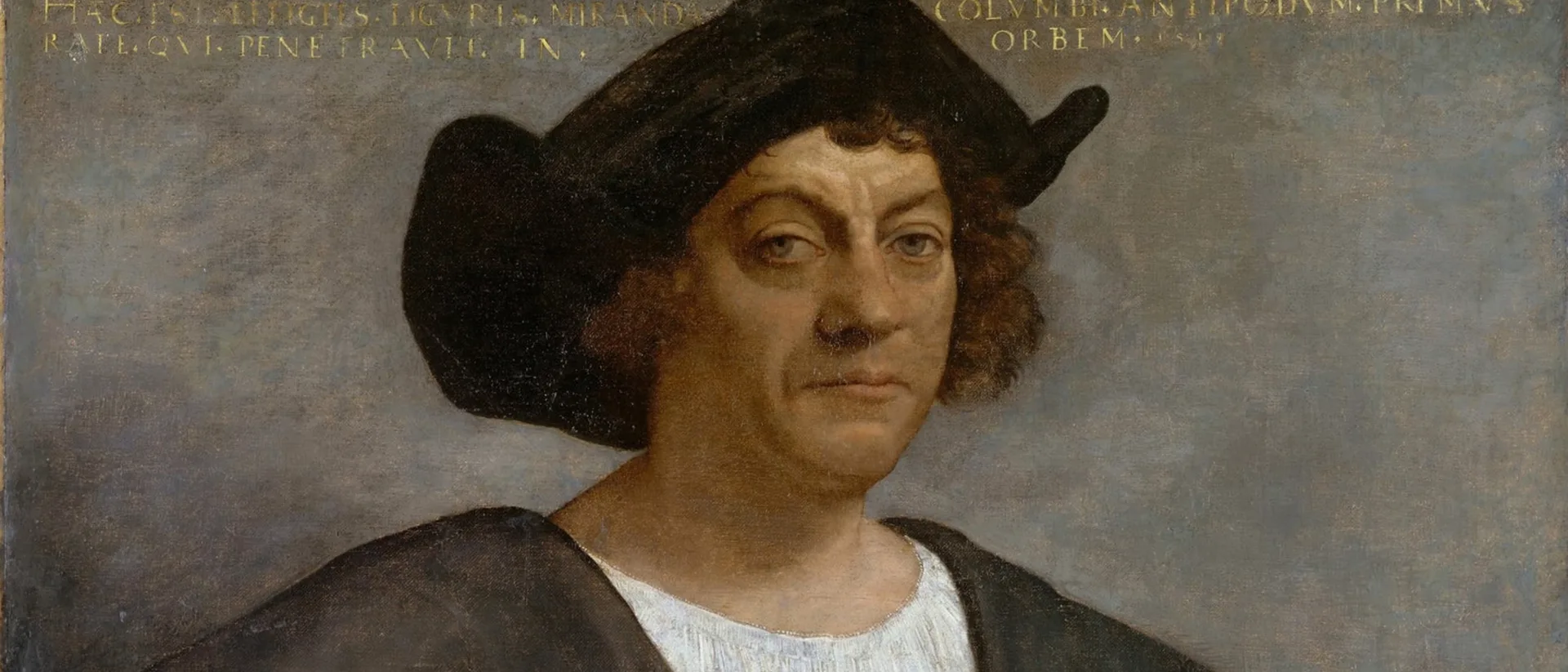
Christopher Columbus wrote about the trafficking of Indigenous girls in his own letters. Girls as young as 9 were, in his words, in high demand. This is not interpretation — it's his handwriting.
The Explorer's Own Words
You learned about Christopher Columbus in school. You learned about ships and navigation and a flat Earth myth. You did not learn what he wrote in his own letters, because no school curriculum on Earth would print it.
The Letter
In a 1500 letter to Dona Juana de la Torre, a friend of the Spanish Queen, Columbus wrote about the trafficking of Indigenous women and girls in the colonies he governed. He noted that girls "from nine to ten are now in demand" and that dealers were actively seeking them.
This is not a historian's interpretation. It is not inference. It is Columbus's handwriting, preserved in the Spanish archives, translated and published in multiple academic collections.
Governor of Hispaniola
Columbus was not merely an explorer. From 1492 to 1500, he served as governor of the colony of Hispaniola (modern-day Haiti and the Dominican Republic). Under his rule, the Taíno people were subjected to a system of forced labor called the encomienda.
Those who failed to meet gold quotas had their hands cut off. Those who resisted were hunted with dogs. The population of Hispaniola, estimated at 250,000 when Columbus arrived, dropped to fewer than 500 within 50 years.
His Own People Turned on Him
Columbus was so brutal that even the Spanish Crown intervened. In 1500, Francisco de Bobadilla was sent to investigate. He found Columbus and his brothers ruling through terror — public dismemberment, execution without trial, and systematic abuse of the native population.
Columbus was arrested, shackled, and sent back to Spain in chains. He was stripped of his governorship. The Crown, which had authorized colonization and slavery, decided that he had gone too far.
The Holiday
Columbus never set foot on the North American mainland. He did not discover that the Earth was round — educated Europeans already knew that. What he did was govern a colony so violently that his own sponsors removed him, and write letters documenting the trafficking of children in his own hand.
The holiday named after him celebrates a version of the man that exists nowhere in the historical record. The real Columbus is in the archives, in his own words, describing things that would be classified as crimes against humanity if they happened today. They happened then. We named a holiday after him anyway.
Frequently Asked Questions
Did Columbus really write about trafficking girls?
What happened to the Indigenous population under Columbus?
Was Columbus ever punished?
Did Columbus discover America?
Related Topics
More from Time