The number of possible chess games (the Shannon number) is around 10^120. The number of atoms in the observable universe is only about 10^80. You could play a unique chess game every second since the Big Bang and never repeat—not even close.
Every Chess Game Ever Played Is a Ghost in an Empty Cathedral
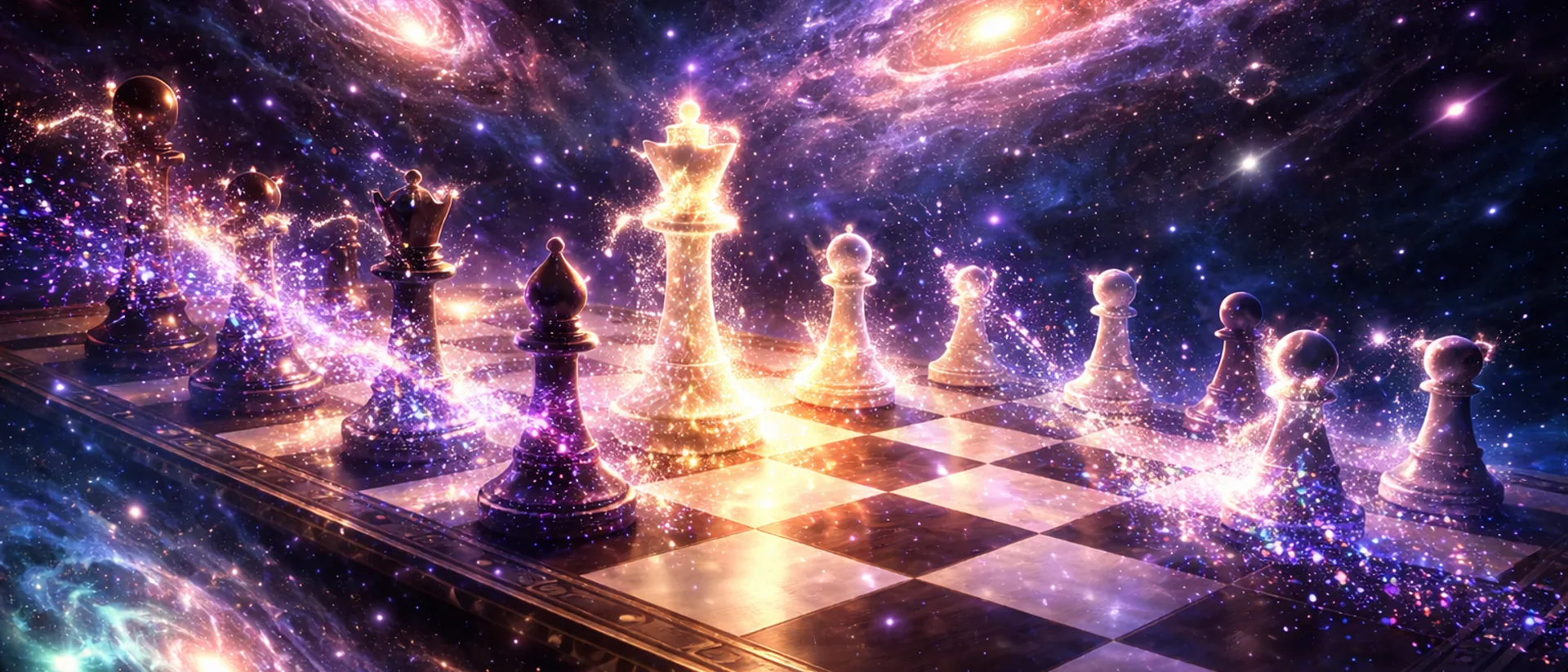
You probably think a chessboard is a finite, knowable space. In reality, the possible games it contains outnumber every atom in the observable universe by a factor so vast it renders the cosmos itself a footnote.
- The Scale: The Shannon number of possible chess games (~10120) dwarfs the estimated atoms in the observable universe (~1080) by a factor of 1040—that's 10,000,000,000,000,000,000,000,000,000,000,000,000,000,000.
- The Time: Playing a unique game every second since the Big Bang would use less than one trillionth of a trillionth of a percent of all possible games.
- The Space: If each atom in the universe could store one complete chess game, you would need a billion universes just to begin the catalog.
- The Mind: This number emerges not from physics or cosmology, but from the simple, human-defined rules of a board game.
The Illusion
We perceive chess as a contained system. It has 64 squares, 32 pieces, and a clear rulebook.
This creates the comforting illusion of mastery. We believe the game's possibilities are finite and, in theory, knowable.
We map openings, study endgames, and build databases of millions of played games. This is the map we mistake for the territory.
The Truth
The truth is a mathematical abyss hidden beneath 64 black and white squares. Claude Shannon's 1950 calculation didn't just give us a big number.
It revealed that a human invention can generate a combinatorial space that utterly humbles physical reality. The universe, for all its stellar furnaces and galactic swirls, contains a mere 1080 atoms.
The game on your coffee table contains 10120 potential narratives. This isn't complexity. It is a form of infinite finitude.
The game is bounded, yet its internal universe is incomprehensibly larger than the one containing it.
The Implication
This means the realm of abstract possibility is not bound by the limits of the concrete world. A system of logic, born in a human mind, can eclipse the scale of its creator's entire physical reality.
We are not just explorers of a vast cosmos. We are architects of spaces more vast than the cosmos itself. Every move you ponder on a chessboard is a step into a shadow universe of potentiality that dwarfs the material one.
Our games, our mathematics, our logic—these are not mere reflections of reality. They are portals to scales of existence that reality cannot physically contain.
So the next time you look at a chessboard, consider this: you are not looking at a game. You are looking at a window. Beyond it lies a silent, waiting expanse of unwritten stories so numerous that if every atom in the sky became a scribe, they could not record them all. What other infinities have we casually designed, and are now blindly sitting inside of?
Frequently Asked Questions
Does this mean the universe is 'smaller' than a thought?
What does the Shannon number imply about human consciousness?
If the possibilities are so vast, is true mastery of chess impossible?
Verified Fact
The Shannon Number (10^120) is a well-established lower-bound estimate for the game-tree complexity of chess, first calculated by Claude Shannon. The estimate of 10^80 atoms in the observable universe is the standard figure used in cosmology and astrophysics.
View source