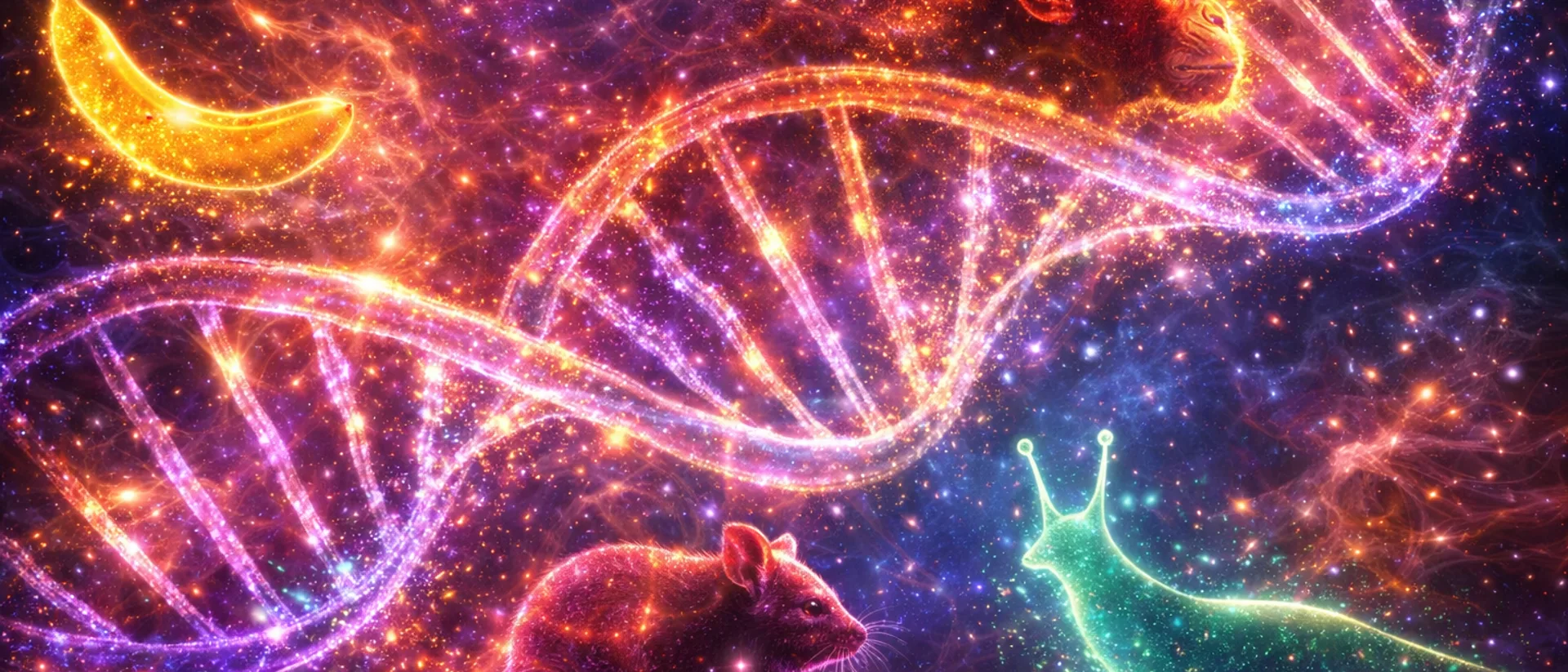
Humans share about 25% of their protein-coding genes with bananas—the ancient "housekeeping" genes essential for all cellular life. You share 85% with mice, 96% with chimps, and surprisingly much with slugs. The genetic code of life is so conserved that we are essentially variations on a 4-billion-year-old theme.
You Are Not an Individual. You Are a 4-Billion-Year-Old Echo.
You probably think your DNA is a unique blueprint, the exclusive architectural plan for a human being. In reality, it is a staggeringly ancient, endlessly recycled library, and you share 60% of its core instructions with the banana on your counter.
- Shared Ancestry: You are 85% genetically identical to a laboratory mouse.
- Cosmic Cousin: A chimpanzee shares 96% of your active genetic code.
- Primordial Thread: Even a garden slug operates with a genetic script 70% similar to your own.
- Time Scale: The core genetic language was established over 4 billion years ago and has never been rewritten, only edited.
The Illusion
You perceive yourself as a discrete, autonomous entity. Your consciousness feels novel, your body feels uniquely yours. This is the biological narrative of selfhood. We are taught to see vast, unbridgeable chasms between kingdoms of life. The human, the animal, the plant—they appear as separate creations. Your genetic code feels like a personal signature, a biological patent filed at your conception.
The Truth
The truth is that life only invented the instruction manual once. Approximately 4 billion years ago, the first successful self-replicating molecule stumbled upon a workable code. Every organism since is a variation, an edit, a remix of that original text. The genes that guide the development of your limbs are hauntingly similar to those that guide a mouse's paw, a bat's wing, and a whale's flipper. They are the same ancient commands, reinterpreted. The fundamental processes of reading DNA, building proteins, and converting food to energy are universal constants, conserved with a fidelity that borders on the religious. You are not reading a unique book. You are reciting a specific verse from a cosmic epic written in atomic ink.
The Implication
This shatters the concept of biological solitude. Individuality is a surface phenomenon, a temporary configuration of near-eternal parts. The 'you' that you identify with is a fleeting arrangement of components that have existed, in different forms, for epochs. The atoms in your hand have been part of stars and stones; the code in your cells has been part of ferns and fish. You are not a closed system. You are a localized convergence of ancient, wandering information. The barrier between 'you' and 'nature' is a perceptual illusion. You are nature, currently experiencing itself through a human-shaped lens. Your humanity is not a departure from life's theme, but a specific, intricate variation played on its oldest instrument.
So the next time you feel separate, remember: the same core programming that allows a banana to ripen allows your neurons to fire. You are listening to the same 4-billion-year-old song. The only question that remains is, what note will you play next before the music rearranges you once more?
Frequently Asked Questions
Does sharing 60% of DNA with a banana mean I'm mostly banana?
What does this genetic conservation imply about the origin of life?
If the code is so old and shared, what actually makes a human different from a slug?
Verified Fact
Percentages are approximate and depend on measurement methods (coding vs. non-coding DNA, gene vs. genome comparison), but the core fact of extreme genetic conservation across all life is a cornerstone of evolutionary biology.
View sourceRelated Topics
More from Science