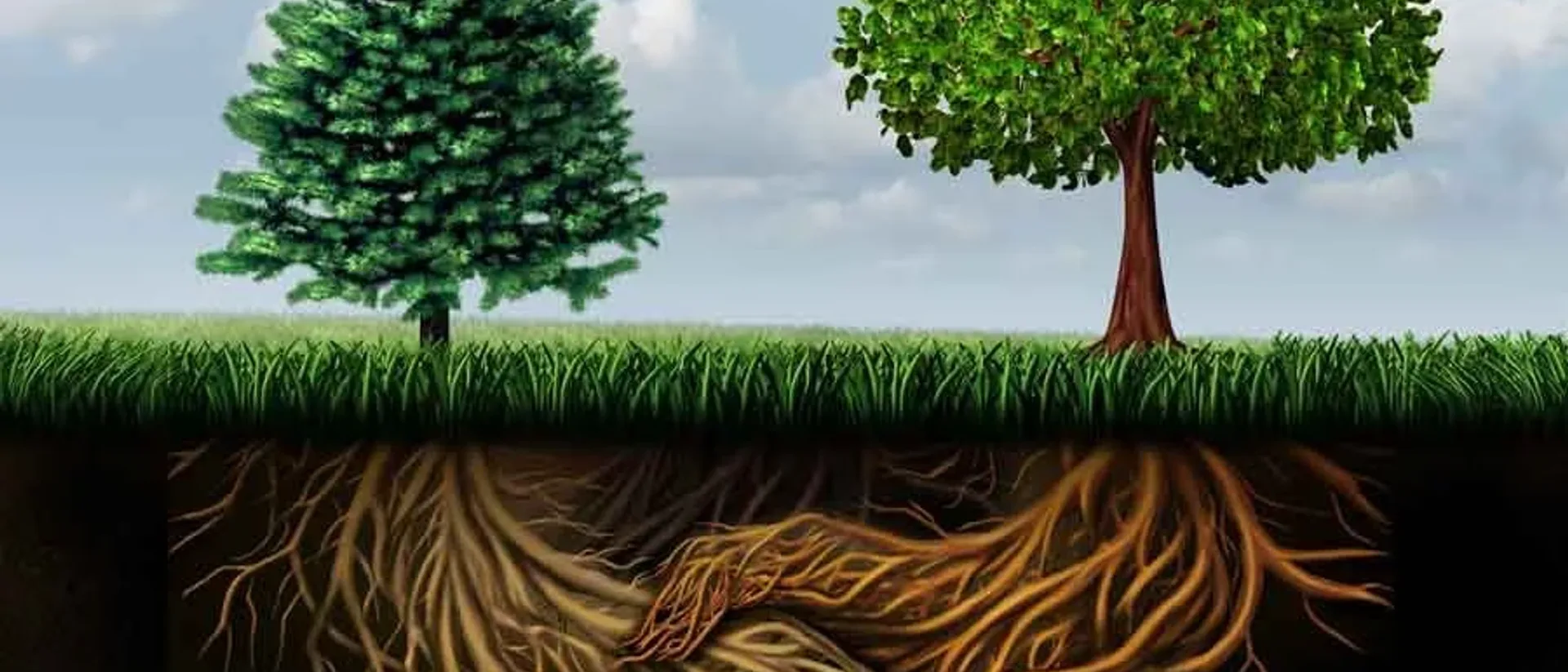
Forests have their own "Wood Wide Web"—a network of fungal threads connecting trees underground. Mother trees recognize their offspring and send them extra nutrients. Dying trees dump their resources into the network as a final gift to the forest.
A Forest Isn't a Collection of Trees. It's a Single Organism.
You probably think a forest is just a collection of individual trees competing for sunlight and soil. In reality, it is a single, sentient superorganism, communicating, nurturing its young, and sharing a collective memory through a subterranean fungal network that functions as its nervous system.
- The Network: Miles of fungal threads, called mycorrhizae, connect the roots of nearly every tree, creating a biological internet dubbed the "Wood Wide Web."
- Recognition: So-called "Mother Trees" can identify their own seedlings through chemical signals in the network and shunt extra carbon and nutrients to them.
- Altruistic Death: When a tree is dying, it doesn't just fall. It performs a final act of legacy, dumping its entire store of resources into the fungal network for the benefit of the community.
- Collective Defense: Trees under attack by insects can send chemical warnings through the network, prompting neighboring trees to preemptively produce defensive toxins.
The Illusion
We perceive the forest as a passive backdrop. A setting for our stories. We see trees as solitary, silent pillars, engaged in a quiet, lifelong struggle against each other for a patch of sky.
This is the story of nature we've told for centuries. Survival of the fittest. Every organism for itself. The forest floor is just dirt, a stage for this competition. Our language betrays us: we speak of "stands" of trees, as if they are merely standing there, alone.
The Truth
Beneath your feet lies a vast, intricate web. This fungal network, the mycorrhizal network, is the forest's true architecture. It is not a metaphor. It is a physical, electrochemical infrastructure.
Through this web, trees conduct a form of arboreal conversation. They trade nutrients. They send distress signals. A Douglas fir under siege by bark beetles can alert a ponderosa pine meters away, giving it time to arm its defenses.
Most hauntingly, they exhibit something we can only describe as familial care. A mature "mother" tree, through root connections, can recognize its own genetic offspring. It will then divert a significant portion of its photosynthetic wealth—carbon, nitrogen, water—to those specific seedlings, increasing their chance of survival fourfold.
The Implication
This redefines what it means to be an individual. Where does one tree end and the forest begin? The boundary dissolves. The tree you lean against is not a solitary entity. It is a node in a vast, living network.
Its roots are intertwined with miles of fungal filaments that are, functionally, the forest's collective root system and neural pathways. The forest thinks, remembers, and cares as one being. Your hike is not through a collection of plants. You are traversing the skin of a colossal, slow-moving consciousness.
The death of a tree is not an end. It is a deliberate redistribution. A dying tree will unload its accumulated resources—a lifetime of captured sunlight and mined minerals—directly into the fungal network. This isn't decay. It is a bequest. A final gift to the community that sustained it.
The Lingering Thought
We walk on a planet covered in these vast, interconnected brains. They operate on timescales we can barely perceive—a warning signal may travel at a speed of centimeters per hour. Their memory is written in chemical shifts and fungal growth patterns over centuries.
If intelligence is the processing of information for the benefit of a community, then the forest is intelligent. If sentience is an awareness of and response to one's kin, then the forest is sentient. We have been walking on a thinking, feeling, communicating world this whole time, mistaking its profound silence for emptiness.
Frequently Asked Questions
Does this mean a forest is literally a single conscious being?
What does the 'Wood Wide Web' imply about human individuality?
If trees care for their young, does this redefine 'natural selection'?
Verified Fact
The concept of the mycorrhizal network facilitating resource transfer and communication is well-established in ecology (Simard et al., 1997, Nature). The specific behaviors of 'mother trees' and resource redistribution by dying trees are supported by subsequent peer-reviewed research.
View sourceRelated Topics
More from Nature