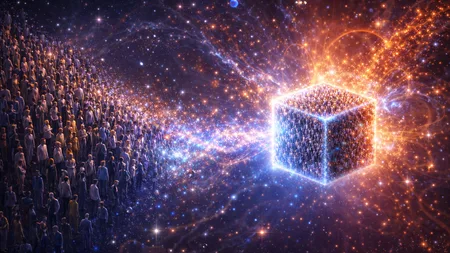

Electrons do not exist in any specific place until measured. Before observation, they exist as probability clouds. Reality requires witnesses.
The Unseen World: Where Reality Waits for a Witness
An electron isn't a tiny ball orbiting an atom. It's a ghost of potential, a smear of probability, until a conscious act of measurement forces it to choose a single reality. The universe at its most fundamental level is not a collection of things, but a tapestry of possibilities waiting for a witness.
What Is a "Thing" Before You Look?
We imagine the subatomic world as a miniature solar system. This is a comforting lie. Before measurement, an electron has no definite position or momentum. It exists everywhere it possibly could be, described by a mathematical probability cloud.
This isn't a limitation of our technology. It's a statement about the nature of reality itself. The electron is not hiding. It is, in a profound sense, not fully real until the moment it is observed.
The Observer's Unavoidable Role
This leads to the unsettling heart of quantum mechanics. The act of looking doesn't just discover a pre-existing state. It participates in creating it. The observer collapses the wave function, forcing a single outcome from infinite potentials.
Is consciousness the trigger? Or is any interaction with the wider universe enough? The debate rages. But the implication is cosmic. Reality, it seems, is not a passive stage. It is a dialogue.
A Universe of Potential, Not Substance
Zoom out from the electron. If the building blocks of matter are probabilistic, what does that make the table you're touching? It is a statistical illusion of solidity, an emergent property of countless quantum decisions.
The chair, the mountain, your own hand—all are vast, buzzing clouds of probability momentarily convinced they are solid. At the quantum scale, the universe is fundamentally fuzzy and undecided.
The Existential Echo in the Void
This isn't just physics. It's a mirror held up to human experience. We navigate a world we believe is concrete and independent. Quantum theory whispers that this concrete world is a consensus reality, shaped by interaction.
It suggests that at the core of existence lies not certainty, but potential. Not being, but becoming. The universe may not be a clockwork machine, but a story being told, with each observation writing a sentence. You are not just reading the story. You are holding the pen.
Frequently Asked Questions
Does this mean nothing is real unless I'm looking at it?
What does 'observation' actually mean in quantum physics?
Is the famous Schrödinger's Cat thought experiment related to this?
How do we know this is true and not just a theory?
Verified Fact
This describes the standard Copenhagen interpretation of quantum mechanics, specifically the concept of wave function collapse upon measurement. It is a foundational, experimentally verified principle, though other interpretations (like Many-Worlds) exist.
View sourceRelated Topics
More from Science