
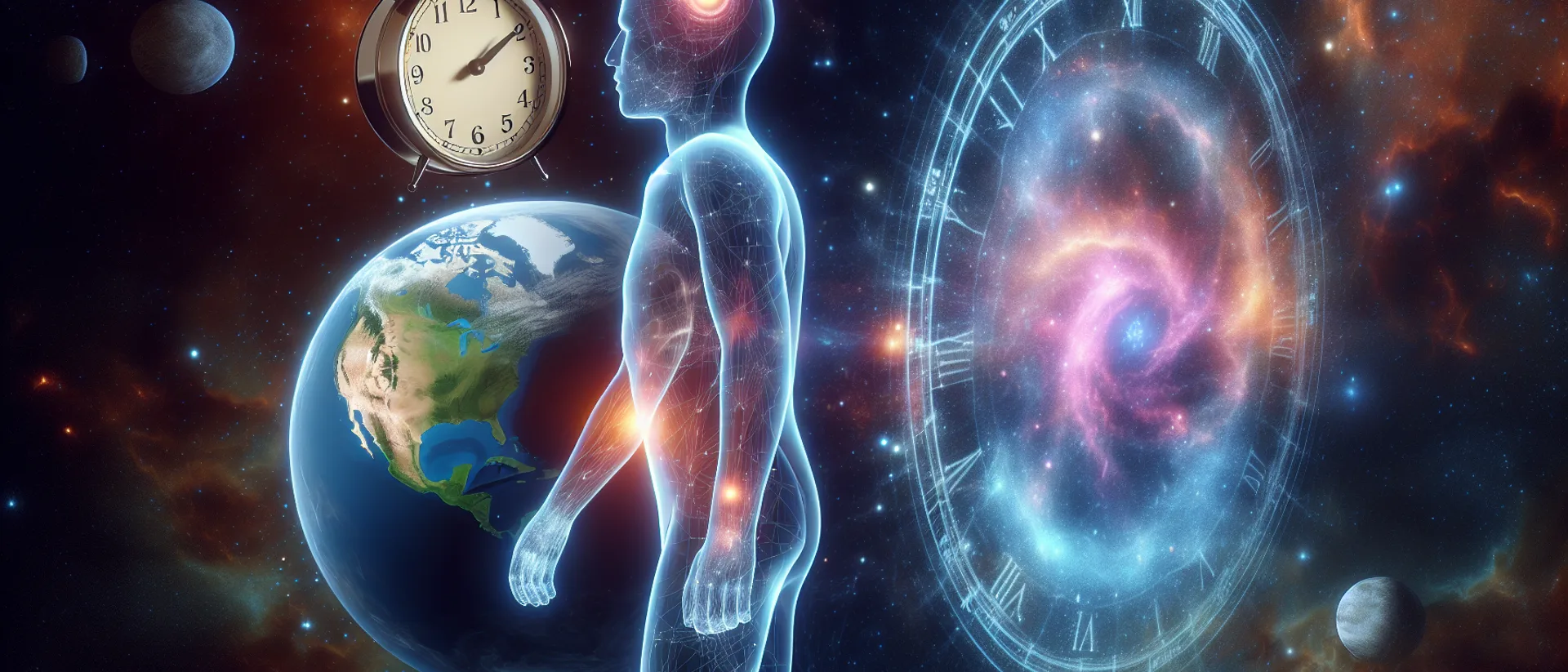
Due to general relativity, time passes very slightly faster for your head than your feet because your head is further from Earth's gravitational center. Over a 79-year lifetime, your head ages about 90 nanoseconds more than your feet.
You Are Not Aging All at Once
You probably think your entire body exists in the same "now." In reality, time flows at a different speed for your head than it does for your feet. You are not a single point in time—you are a smear of slightly different temporal realities stacked six feet tall.
- Scale: For every 79 years you live, your head ages about 90 billionths of a second more than your feet.
- Cause: Your head is fractionally farther from Earth's gravitational center, placing it in a slightly weaker gravitational field.
- Rule: Einstein's theory of general relativity states that time slows down in stronger gravity. Your feet are deeper in Earth's gravity well.
- Paradox: Your conscious experience stitches these disparate time streams into a single, seamless present—an illusion of unity.
The Illusion
You experience your body as a unified whole. Every part of you feels simultaneous. Your thoughts, your heartbeat, the sensation in your toes—they all seem synchronized within a single, shared moment called "now." This feels self-evident. It is the bedrock of your physical reality. Your watch ticks the same for your wrist as it would for your ankle, or so you believe. This intuition is powerful, visceral, and profoundly incorrect.
The Truth
Gravity is not just a force that pulls. It is the curvature of spacetime itself. The stronger the gravity, the more spacetime is warped, and the slower time flows. This is not theoretical. It is measured daily by the atomic clocks on GPS satellites, which must be corrected for this effect or your navigation would fail within minutes. Your body is a vertical tower in Earth's gravity field. Your feet experience marginally stronger gravity than your head. Therefore, for your feet, time crawls just a little slower. The difference is vanishingly small—a few femtoseconds per second—but it is real and relentless. Over decades, the divergence adds up to a measurable, if tiny, age gap.
This means the "you" that is reading this is, technically, not the same age from top to bottom. Your brain has experienced more time than your heart. Your heart has experienced more time than your liver. Your lived experience is a temporal mosaic, not a monolith.
The Implication
This fact dismantles the notion of a universal "present." There is no single "now" that blankets your body. Your personal timeline is not a line but a gradient. The you that exists is an average, a consensus formed by a biological system operating across a subtle time slope. Your consciousness performs a staggering act of synchronization, weaving these infinitesimally out-of-sync signals into a coherent experience. It is an illusion so perfect you never question it.
Extend this principle outward. If a two-meter height difference creates a time discrepancy, imagine the scale of the universe. A person living on a mountain top ages faster than someone at sea level. An astronaut on the ISS ages slower than their twin on Earth. "Now" is a local phenomenon, shattered across space by gravity and velocity. The shared present you feel with someone across the room is a convenient fiction, a trick of scale and perception.
So, what are you? You are not an object in time. You are a process, stretched across spacetime, integrating differential time flows into a narrative self. The unity you feel is a biological achievement, not a fundamental truth.
If "you" are spread across time within your own body, where does the conscious "you" actually reside? Is it in the slightly older neurons of your brain, trying to make sense of signals from the slightly younger rest of you? And if not, what is it that holds this fragile temporal consensus together?
Frequently Asked Questions
Does this mean my thoughts are older than my feelings?
If time is relative within my own body, is there a true "self" at a single moment?
What would happen if the time difference were larger, like seconds or minutes?
Does this imply immortality is impossible because you can't even keep your own cells in sync?
Verified Fact
Verified via experimental tests of gravitational time dilation, including the 1976 Gravity Probe-A experiment and continuous validation through GPS satellite clock corrections. The 90-nanosecond figure for a 79-year lifespan at a 2-meter height difference is a standard calculation in general relativity.
View source